
we've all been lied to more than we realize
and now we have to re-learn how to learn.
I've asked people I look up to for information about the middle eastern conflict throughout my life, and I heard a lot of "it's complicated." For some reason I accepted that? Like "this is hard to learn, so I'm not going to try"? I'm embarrassed. I don't know how complicated something has to be for us all to collectively choose ignorance.
But I think what they really meant was "if we talk about this, we have to wrestle with the guilt of being complicit in occupation and genocide, and guilt is a complicated emotion so let's not even go there."
But it's time we go there. We have to accept the reality of the world we live in, not the world we wish we lived in, not the world that would be easier. We're here. Let's learn what exactly that means, so we can change what needs to be changed, and try to undo the damage we've been doing.
a list of links to more information on palestinian history

Quick history of Palestine Before 1948
A Timeline (and a site well worth exploring, so click around)
Information about history, and lots of footage from Palestine. To be honest, seeing The rubble and encampments through drone view, organized in a public database for people interactively engage with the horror of reality feels like a Black Mirror episode, or like the Hunger Games. We're all spectators in the collision of late stage capitalism and settler colonialism. I'm afraid that there are people out there exploiting genocide for clout on social media, and the ties of our relationship to each other as humans across the world have gotten so tight. We are all responsible for each other, now that we have seen the cost of status quo.
https://remix.aljazeera.com/aje/PalestineRemix/timeline_main.html
Another Timeline because, please, I beg of you, get your facts from multiple sources
And question the agenda behind every source you get your information from. We need to work on being more critical of our sources, that goes for everybody. Everything, and I mean everything is said with an agenda, so just be aware of that as you educate yourself.
That said, here is a historical timeline of Palestinian occupation, from the neutral (if admittedly ineffective) organization, that is the United Nations, which should serve as an unbiased source.
Palestine Open Maps
A very cool interactive map exploration tool, which allows you to split screen historic maps and present day maps to view side by side, as well as view data on places that have existed throughout history.
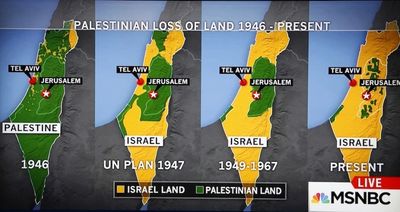
palestinian loss of land, 1946- present
remind me, who needs to defend themselves?
MSNBC's release of this map sparked controversy and pushback from Israeli's, claiming it is incorrect. Israel did not exist until 1948, so technically calling any of the land Israel in 1946 is incorrect. The other factual error is that it shows the Syrian Golan Heights, which have been under Israeli military occupation since the 1967 War, as part of Israel, although the international community, including the United States, does not recognize Israeli sovereignty over the area. Any other questions?
For more details, read here:
https://imeu.org/article/fact-check-msnbcs-palestinian-loss-of-land-map
moments in history through photos
The Balfour Declaration (photo of Balfour Day of Mourning, 1929)
Palestinian children who became refugees in Gaza following the Nabka, 1949
The Balfour Declaration (photo of Balfour Day of Mourning, 1929)

Prior to the Balfour Declaration (1917), Jewish people made up less than 10% of the population of Palestine. This declaration was a British mandate to form a Jewish national home.
“made by a European power … about a non-European territory … in a flat disregard of both the presence and wishes of the native majority resident in that territory”. - Edward Said
The Old City in Jerusalem before Nabka, 1930's
Palestinian children who became refugees in Gaza following the Nabka, 1949
The Balfour Declaration (photo of Balfour Day of Mourning, 1929)
Photo featuring the Dome of the Rock, Islam's 3rd holiest site. It is part of the Al Aqsa complex, built in the 7th century. This photo shows it before it received its gold plating.
Palestinian children who became refugees in Gaza following the Nabka, 1949
Palestinian children who became refugees in Gaza following the Nabka, 1949
Palestinian children who became refugees in Gaza following the Nabka, 1949
Over 80% of Gaza's population are refugees or the descendants of the 250,000 refugees who escaped to Gaza after being expelled by Zionist militias from their villages and cities.
(I hope I don't have to spell out the parallels between Israeli occupation of Palestine and what US did and is still doing to Native Americans. I hope you can make that connection on your own.)
The 6 Days War, June 5, 1967
Raid on Palestinian non-profit organizations, August 18, 2022
Palestinian children who became refugees in Gaza following the Nabka, 1949
The Six-Day War began with a preemptive Israeli air assault in Egypt and Syria. (Preemptive meaning, Israel was picking fights, not defending itself) An Israeli ground offensive was also launched in the Sinai Peninsula, the Golan Heights, the Gaza Strip, and the West Bank. These territories were all captured by Israel, though the Sinai Peninsula was later returned to Egypt.
18,000 Arab soldiers died. Compared to 800 Israeli.
Great March of Return, 2018-2019
Raid on Palestinian non-profit organizations, August 18, 2022
Raid on Palestinian non-profit organizations, August 18, 2022
Under international law, Palestinians have the right to return to the land that was brutally stolen from them during the Nabka and ethnic cleansing. Instead of facilitating this, as they are legally required to do, Israel killed 226 Palestinian protestors and wounded over 36,000. The UN said it looks like war crime, but Israel says no.
Raid on Palestinian non-profit organizations, August 18, 2022
Raid on Palestinian non-profit organizations, August 18, 2022
Raid on Palestinian non-profit organizations, August 18, 2022
Israel raids the headquarters of 7 Palestinian nonprofit organizations which it unlawfully designated as terrorist organizations the previous year. These organizations were dedicated to the protection of human rights and advocated for international rule of law. This raid came during what was one of the deadliest recent years of Israeli occupation, but pales in comparison to what we see now.